
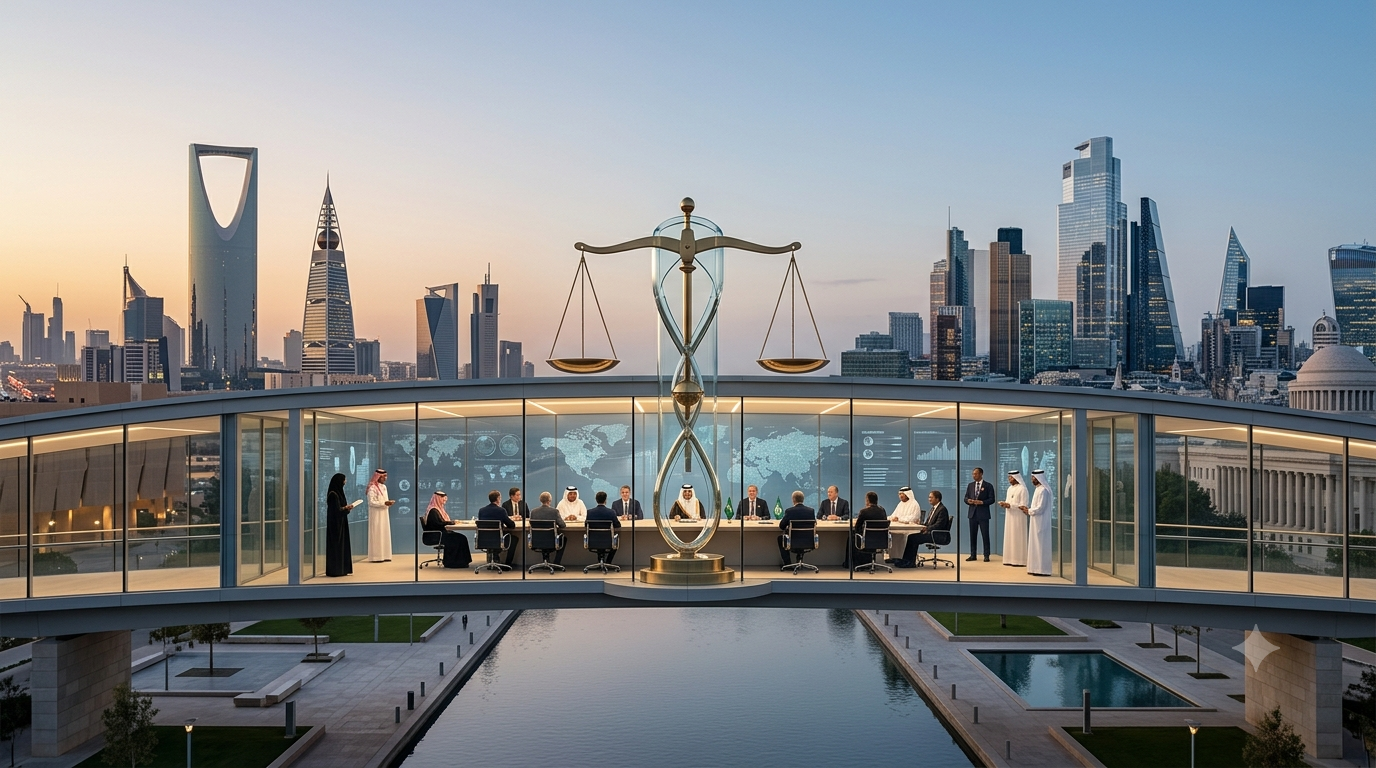
“Human rights should be universal enough to criticise Riyadh, London, Washington and Berlin without fear or favour.”
Saudi Arabia’s human rights record remains one of the most challenging issues in its relationship with Western audiences. It cannot be ignored, and it should not be dismissed. Concerns over the death penalty, freedom of expression, migrant workers, detention, civil liberties and women’s rights continue to shape how the Kingdom is discussed in Western media, politics and civil society [1][2].
But there is another question that also deserves attention: why is Saudi Arabia so often discussed as though human rights failures are uniquely Saudi, uniquely Arab, uniquely Muslim or uniquely non-Western?
That is where the debate becomes less honest.
A serious discussion of Saudi Arabia’s human rights record must acknowledge the criticisms. But a fair discussion must also recognise the double standard that can shape Western commentary. Western governments and media institutions sometimes speak about human rights as though they are neutral observers standing above the rest of the world. Yet the same international organisations that criticise Saudi Arabia also criticise the United Kingdom, the United States, Germany and other Western democracies for failures involving protest rights, asylum policy, policing, racial inequality, detention, poverty and migration [3][4][6].
This does not mean Saudi Arabia should escape scrutiny. It means scrutiny should be consistent.
The West is not a single actor. Western governments, courts, journalists, civil-society organisations and voters frequently disagree, and many Western institutions actively expose abuses within their own countries. The criticism here is therefore not directed at every Western voice, but at selective framing when comparable principles are applied unevenly.
The problem is not criticism – it is selective criticism
Western criticism of Saudi Arabia is not automatically unfair. Some of it is serious, evidence-based and legitimate. Human Rights Watch and Amnesty International continue to raise concerns about executions, restrictions on freedom of expression, migrant worker abuses and the treatment of critics and activists in Saudi Arabia [1][2].
A credible Saudi-facing publication should not pretend these concerns do not exist. To do so would weaken the argument, not strengthen it.
But the problem begins when Saudi Arabia is treated as though it alone represents human rights failure, while Western countries are treated as flawed but fundamentally virtuous. In Western discourse, Saudi Arabia’s failures are often presented as evidence of national character. Western failures, by contrast, are more often presented as policy challenges.
That distinction matters.
When Saudi Arabia is criticised, the criticism can become civilisational: the Kingdom is portrayed as inherently oppressive or incompatible with modernity. When Western states violate rights, the language is often softer: the issue becomes “controversial legislation”, “border pressure”, “security policy”, “public order”, “migration management” or “policing concerns”.
The moral framing is different. Comparable rights questions may be judged through different lenses.
That is the double standard.
Consistency does not require false equivalence. The severity, scale, legal context and availability of remedies differ between countries. Comparison is useful only when it tests whether the same underlying principles are being applied consistently.
Western countries also face serious human rights criticism
The West is not outside the human rights debate. It is inside it.
In the United Kingdom, Human Rights Watch’s 2026 reporting criticised restrictions on protest, the use of anti-terrorism legislation, rising poverty and inequality, and the mainstreaming of anti-immigration narratives [3]. These are not minor matters. The right to protest is a core democratic freedom. The treatment of migrants and asylum seekers is a human rights issue. Poverty and inequality affect dignity, family life, health and opportunity.
In the United States, Amnesty International’s 2025/26 reporting raised concerns over asylum restrictions, immigration enforcement, violations of protesters’ rights, reduced protections for LGBTI people, attacks on reproductive rights, lethal police force disproportionately affecting Black people, continued use of the death penalty and indefinite detention at Guantánamo Bay [4].
In June 2026, the UN human rights office reported that 19 people had died in US Immigration and Customs Enforcement detention during the year and called for prompt, independent, impartial and effective investigations into all deaths in ICE custody [5].
Germany, often viewed as one of Europe’s strongest liberal democracies, has also faced criticism. Human Rights Watch’s 2026 Germany chapter raised concerns over migration and asylum policy, hate crimes, hate speech, and restrictions on freedom of expression and assembly, particularly around Palestine-solidarity protests [6].
These examples do not make Saudi Arabia’s challenges disappear. But they do show that human rights issues are not confined to the Gulf, the Middle East or the Global South. Western states also fall short of the principles they promote internationally.
The death penalty exposes the inconsistency
The death penalty is one of the strongest criticisms levelled against Saudi Arabia, and rightly so. Amnesty International recorded at least 356 executions in Saudi Arabia in 2025 – the highest annual total it had documented in the Kingdom – including 240 executions for drug-related offences [7]. Human Rights Watch also highlighted the scale of executions and concerns over due process [2].
The same Amnesty International reporting recorded 47 executions in the United States during 2025 [7]. The numbers and systems are plainly not equivalent: Saudi Arabia’s use of capital punishment was far greater. Nevertheless, the United States remains a Western democracy that retains and actively uses the death penalty.
One recurring difference lies in framing. Capital punishment in the United States is generally discussed as a contested domestic policy within a democratic system. Saudi Arabia’s use of the death penalty is more often folded into a wider judgement about the Kingdom’s culture, political system and compatibility with modernity.
A fairer debate would say this: Saudi Arabia should face serious scrutiny over executions, especially where non-violent offences, foreign nationals, offences allegedly committed when defendants were under 18, or unfair trials are involved. But Western countries that retain capital punishment or enable other serious rights violations should be honest about their own records before presenting themselves as neutral moral judges.
Migration and labour: different systems, shared obligations
Saudi Arabia is often criticised for the treatment of migrant workers, and this criticism remains significant. Rights organisations report that migrant workers continue to face abuse, wage theft, exploitation and restrictions linked to the sponsorship system despite labour reforms [1][2].
This issue matters deeply because migrant workers are central to Saudi Arabia’s construction, domestic work, logistics, hospitality and infrastructure economy. As the Kingdom presents itself as a modern global destination and prepares to host the 2034 FIFA World Cup, worker protection will be one of its biggest credibility tests [8].
Saudi Arabia’s migrant-labour system and Western asylum and immigration-detention systems are structurally different. They should not be treated as identical. But both can be assessed against common principles: protection from abuse, access to justice, lawful detention and respect for human dignity.
The United Kingdom has faced criticism over asylum laws, anti-immigration rhetoric and restrictions affecting refugee rights [3]. The United States has faced criticism over mass immigration enforcement, detention conditions, asylum access and deaths in immigration custody [4][5].
The double standard is not that Saudi Arabia is criticised for migrant-worker issues. It should be. The double standard arises when Western migration policies are framed only as difficult security or border-management questions, while Saudi labour abuses are treated as evidence of wider moral inferiority.
A consistent standard would examine all migrant, asylum and worker systems through the same questions:
Are people protected from abuse?
Can they access justice?
Can workers change employers freely?
Are wages paid on time?
Are detention and deportation systems lawful and humane?
Are vulnerable people treated with dignity?
Those questions should apply in Riyadh, London, Washington and Berlin.
Human rights and geopolitical convenience
Another uncomfortable truth is that Western governments do not always act according to the human rights principles they publicly promote. They criticise, but they also trade. They condemn, but they also cooperate. They raise concerns, but they also pursue contracts, investment and strategic relationships.
This tension is especially visible in relations between the United Kingdom and Saudi Arabia. The two countries maintain a formal Strategic Partnership Council structured around defence, security and political cooperation, alongside economic and social cooperation [9]. In May 2026, the United Kingdom also concluded a free trade agreement with the Gulf Cooperation Council, which includes Saudi Arabia, although the agreement is not yet in force and still requires domestic procedures and ratification [10].
That does not mean engagement with Saudi Arabia is wrong. Engagement may be more constructive than isolation. But it does show that foreign policy is shaped by a mixture of values, security interests and economic priorities.
Western governments should therefore be transparent about that reality rather than presenting their policies as purely moral judgements. Human rights should not rise and fall in importance according to oil prices, defence contracts, migration politics, election cycles or geopolitical alliances.
Saudi reform should be recognised, not exaggerated
A fairer standard also means recognising reform where reform exists.
Saudi Arabia has changed significantly over the past decade. The most visible progress has been in women’s economic participation, social opening, tourism, entertainment, labour-market development and quality-of-life reforms.
World Bank reporting found that Saudi women’s labour-force participation more than doubled from 17.4% in early 2017 to 36% in the first quarter of 2023. It linked this rise to legal reforms, labour-market programmes and shifts in social norms under Vision 2030 [11].
Saudi official statistics subsequently recorded female labour-force participation at 36.3% in the first quarter of 2025 [12]. Later official reporting placed the rate at 34.5% in the fourth quarter of 2025, showing some quarterly fluctuation but not reversing the long-term structural increase [13].
This matters because human rights and social progress should not be assessed only through criticism. They should also be assessed through change. A society in transition should be judged not only by where it started, but by the direction and substance of reform.
However, reform should not be exaggerated. Women’s workforce participation does not erase concerns about freedom of expression. Tourism growth does not resolve migrant-worker abuse. Legal modernisation does not automatically guarantee independent enforcement. Progress is real, but incomplete.
The strongest argument for Saudi Arabia is not that everything has been fixed. The strongest argument is that the Kingdom is changing – and that change should be measured fairly.
Beyond the language of superiority
The deeper problem in some Western discussion is not merely criticism. It is the language of superiority.
Too often, Saudi Arabia is approached not as a country undergoing complex transformation, but as a country waiting to be judged by others. Western commentary can sound less like universal human rights concern and more like moral ranking: the West as teacher, the rest as pupil.
That approach is outdated.
Western democracies have developed influential human rights institutions and traditions, but their records also contain serious and well-documented failures involving war, detention, policing, racial equality, migration and socioeconomic rights. Their records are mixed rather than beyond criticism.
Saudi Arabia’s record is also mixed. It includes serious concerns, but also significant reform, social change and national transformation.
A mature human rights debate should be honest enough to hold both truths at once.
A fairer standard for Saudi Arabia
So what would a fairer standard look like?
First, Saudi Arabia should be scrutinised using evidence, not stereotype. Criticism should be specific, sourced and focused on law, practice and outcomes.
Second, Western countries should be held to the same moral vocabulary they use for others. If protest restrictions are a human rights issue in Saudi Arabia, they are also a human rights issue in Britain, Germany and the United States. If migrant workers deserve dignity in the Gulf, asylum seekers and detainees deserve dignity in the West.
Third, reform should matter. Countries should not be frozen permanently in old reputations. When Saudi Arabia expands women’s participation, reforms labour rules, opens new public spaces or modernises institutions, those developments should be acknowledged.
Fourth, progress should be tested by implementation. New laws and official targets are important, but the credibility of reform depends on whether ordinary people experience protection, fairness and opportunity in practice.
Finally, human rights should not be used as selective branding. They should be a universal standard, not a geopolitical instrument.
Conclusion: scrutiny without hypocrisy
Saudi Arabia should not ask the world to ignore its human rights challenges. A serious country with global ambitions must be prepared for scrutiny, especially as it seeks investment, tourism, sporting events, cultural influence and international trust.
But the West should also examine the way it scrutinises Saudi Arabia. Too often, Saudi failures are treated as defining features, while Western failures are treated as exceptions. Saudi reform is treated with suspicion, while Western self-correction is treated as proof of democratic strength.
That is not a fair standard.
The better approach is neither blind defence nor selective condemnation. It is consistency.
Saudi Arabia should be judged by evidence, reform and implementation. Western countries should be judged by the same principles. Human rights should be universal enough to criticise Riyadh, London, Washington and Berlin without fear or favour.
The Kingdom’s transformation will be stronger if it continues to address difficult questions openly. But the Western debate will be stronger too if it abandons moral superiority and applies its principles consistently.
A fairer conversation about Saudi Arabia begins with a simple idea: human rights matter everywhere, or they are weakened everywhere.
Sources and Further Reading
[1] Amnesty International, Saudi Arabia 2025, Amnesty International Report 2025/26.
[2] Human Rights Watch, World Report 2026: Saudi Arabia.
[3] Human Rights Watch, World Report 2026: United Kingdom.
[4] Amnesty International, United States of America 2025, Amnesty International Report 2025/26.
[5] United Nations Office at Geneva, UN Geneva Press Briefing: Deaths in US Immigration and Customs Enforcement Detention, 26 June 2026.
[6] Human Rights Watch, World Report 2026: Germany.
[7] Amnesty International, Death Penalty in 2025: Facts and Figures, 18 May 2026.
[8] FIFA, Hosts Appointed for the 2030 and 2034 FIFA World Cups, 11 December 2024.
[9] UK Department for Business and Trade, Kingdom of Saudi Arabia and United Kingdom Strategic Partnership Council: Economic and Social Pillar Joint Statement, 3 September 2025.
[10] UK Department for Business and Trade, UK-Gulf Cooperation Council Trade Deal: Conclusion Summary, published 20 May 2026 and updated 10 June 2026.
[11] World Bank, Economic Diversification Efforts Paying Off in GCC Region, but More Reforms Needed, 22 November 2023.
[12] General Authority for Statistics, Unemployment Rate of Total Population Reaches 2.8% in Q1 2025, 29 June 2025.
[13] Saudi Ministry of Economy and Planning, KSA Economic Pulse, May 2026.