
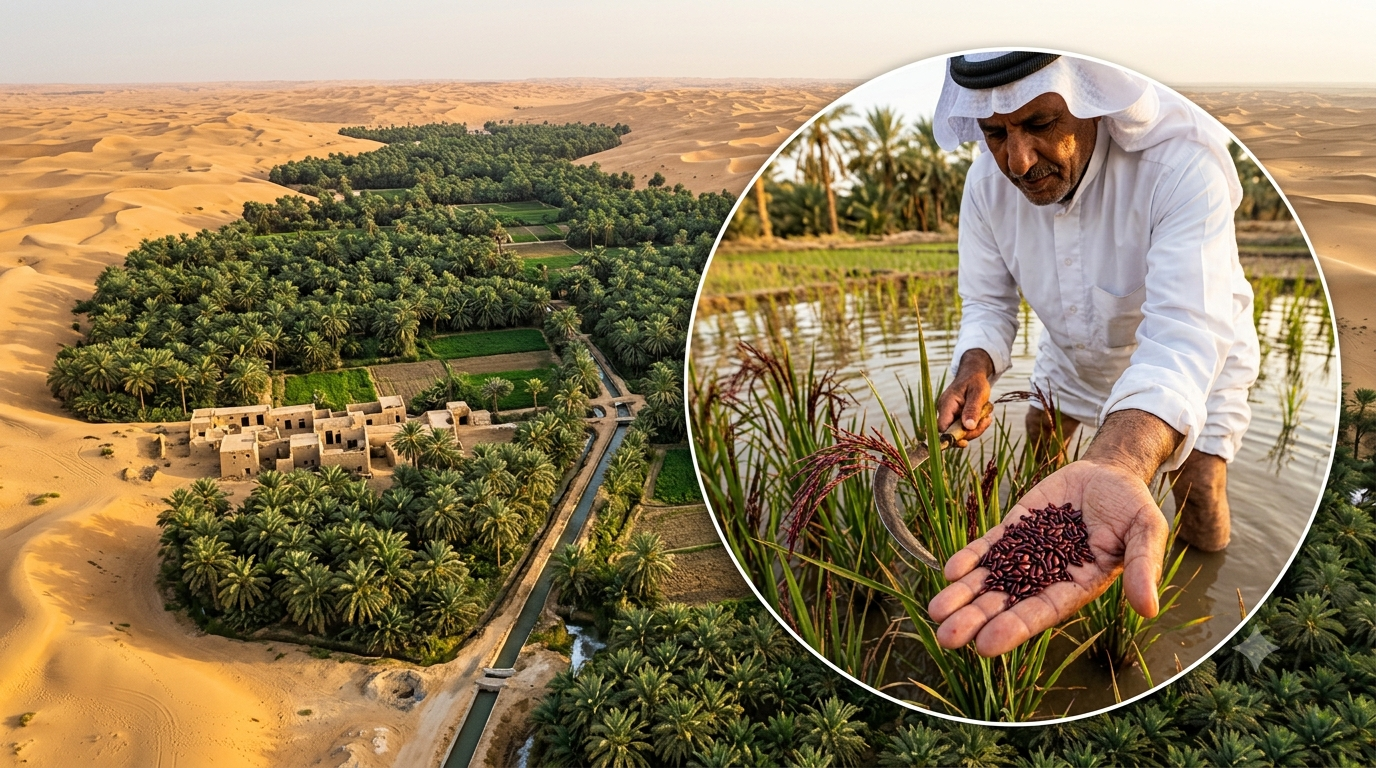
In an oasis dominated by date palms, farmers continue to cultivate an indigenous rice adapted to heat and salinity. Its remarkable survival poses a difficult question: how should Saudi Arabia preserve a water intensive crop in an increasingly water-conscious age?
“Hassawi rice has survived the heat of Al-Ahsa for generations. Its greatest threat may now be the disappearance of the farmers who know how to grow it.”
Rice is not the crop most people expect to find growing in Saudi Arabia.
It is usually associated with the flooded plains and monsoon climates of Asia, not one of the world’s most arid countries. Saudi Arabia imports much of the rice consumed in its homes and restaurants, where basmati and other varieties occupy a central place in meals ranging from kabsa to mandi.
Yet in Al-Ahsa Oasis, in the Kingdom’s Eastern Province, farmers have cultivated a distinctive reddish-brown rice for generations.
Known as Hassawi rice, it is an indigenous Saudi landrace: a crop shaped over time by its environment and by farmers repeatedly selecting and preserving seeds suited to local conditions. It can tolerate high temperatures and saline conditions that would challenge many commercial varieties.[1]
Its dark colour, dense texture and nutty flavour distinguish it from ordinary polished white rice. So does its price. While imported basmati may sell for approximately SAR6–12 per kilogram, Hassawi rice commonly appears in Saudi specialist stores for around SAR28–45 per kilogram.
It is sometimes described as one of the most expensive rice varieties in the world. Such claims are difficult to verify globally, but within Saudi Arabia it is unquestionably a premium product.
The price reflects more than novelty. Hassawi rice is costly because its cultivation is localised, labour-intensive, comparatively low-yielding and dependent upon a farming tradition that is becoming harder to sustain.
Its rarity gives it cultural and commercial value. It also makes its future uncertain.
Rice beneath the palms
Al-Ahsa is one of the world’s largest oasis landscapes. Its springs, canals, wells, agricultural land and millions of date palms have supported settlement over centuries.
The date palm is the oasis’s dominant agricultural symbol, but the landscape has also produced citrus fruit, vegetables, grains and rice. Hassawi rice developed within this particular environment rather than across Saudi Arabia generally.
The palm canopy creates more than a crop. It forms part of an agricultural system in which shade, irrigation and cultivated land make other forms of production possible within an otherwise demanding climate.
Hassawi rice is planted during the hottest part of the agricultural calendar and harvested later in the year. Farmers refer to its harvest season as al-Wasmi, generally falling between November and December depending on the planting date.[2]
The crop’s red-brown colour comes from the outer layers retained around the grain. This distinguishes it visually and nutritionally from highly polished white rice, from which the bran and germ have largely been removed.
Traditionally, Hassawi rice is cooked with spices, meat or broth. It requires more water and a longer cooking time than many white varieties and produces a firm, substantial grain. Saudi Arabia’s Ministry of Culture identifies it as a regional dish of the Eastern Province, historically connected to generosity and hospitality.[3]
Hassawi rice is therefore not merely an agricultural curiosity. It connects seed, soil, cuisine and regional identity.
What does “indigenous” mean?
Calling Hassawi rice indigenous does not mean that rice originated in Saudi Arabia or that no similar red rice exists elsewhere.
Rice was domesticated in Asia, and pigmented rice varieties are grown in several countries. Hassawi belongs to the wider Oryza sativa species and is generally classified within the Indica group.
Its distinctiveness lies in being a Saudi landrace associated with Al-Ahsa.
A landrace is a crop population developed through long interaction between plants, local environmental conditions and farmer selection. Unlike a modern commercial variety bred for uniformity and large-scale production, a landrace carries adaptations accumulated within a particular place.
For generations, Al-Ahsa’s farmers retained seed from crops that performed successfully under local heat, soil and water conditions. Their choices helped shape the rice that survives today.
This gives Hassawi rice two forms of value.
The first is cultural: it forms part of Al-Ahsa’s agricultural identity and culinary memory.
The second is genetic. Traits associated with tolerance of drought, heat or salinity can be valuable to researchers attempting to develop crops for increasingly difficult growing conditions.
Preserving Hassawi rice is therefore not simply about keeping an old food on the menu. It also means conserving biological characteristics that could have future agricultural importance.
Is Hassawi rice more nutritious?
Hassawi rice is frequently promoted as exceptionally nutritious. Some sellers go much further, claiming that it prevents disease, treats joint pain or is automatically suitable for people with diabetes.
The evidence supports a more careful conclusion.
Hassawi rice appears to have a stronger nutrient and antioxidant profile than polished white rice, but it should not be marketed as a medicine.
A study comparing Hassawi rice with white basmati found that Hassawi contained significantly higher concentrations of phenolic compounds and flavonoids and produced greater antioxidant activity in laboratory testing. It also generally contained higher levels of macro- and micro-minerals and water-soluble vitamins, although white basmati was higher in niacin, selenium and boron in that particular comparison.[4]
The study found that Hassawi rice contained more thiamine and riboflavin. Phosphorus and potassium were among its most abundant measured minerals.
Another Saudi research summary reported that Hassawi rice had approximately 30 per cent more protein, 65 per cent more dietary fibre and 15 per cent less starch than the rice varieties used for comparison.[5] These percentages should be treated as study-specific findings rather than fixed values for every Hassawi crop.
Soil conditions, seed line, processing, storage and cooking can all change a food’s measured composition.
Indicative nutritional comparison
| Characteristic | Hassawi red rice | Polished white rice |
| Outer grain layers | Largely retained | Mostly removed during polishing |
| Dietary fibre | Generally higher | Lower |
| Protein | Reported as higher in comparative studies | Generally lower |
| Phenolic compounds | Significantly higher in one direct comparison | Lower |
| Flavonoids | Significantly higher in one direct comparison | Lower |
| Antioxidant activity | Higher in laboratory testing | Lower |
| Mineral content | Generally richer, although results vary by mineral | Reduced by polishing |
| Cooking time | Usually longer | Usually shorter |
| Glycaemic response | Not proven to be substantially lower | Varies by variety and preparation |
The final row is important.
A controlled study comparing Hassawi rice with a commercial long-grain rice found lower rapidly and slowly available glucose during laboratory digestion tests. However, when consumed by human participants, Hassawi rice had a similar glycaemic index to the comparison rice, although it produced a lower insulin response.[6]
That means it would be misleading to tell readers that Hassawi rice is necessarily “low-GI” or that people managing diabetes can consume it without considering portion size and preparation.
It remains a carbohydrate-rich food. Its value lies in providing more fibre, micronutrients and plant compounds than highly refined white rice, not in eliminating the metabolic effects associated with rice consumption.
Why is it so rare?
Hassawi rice is rare because several disadvantages converge around its production.
It grows in a limited area
The crop is closely associated with Al-Ahsa. It is not produced across Saudi Arabia on the scale of dates, vegetables or animal feed.
A geographically restricted crop is more vulnerable to changes in water availability, land use, farmer numbers and local economics.
It has a long growing cycle
Traditional Hassawi rice takes longer to mature than many modern commercial varieties. That ties up agricultural land, water and labour for a longer period before the farmer receives a return.
It produces relatively low yields
The crop was not developed primarily for the high, uniform yields demanded by modern commodity agriculture. Lower productivity means fewer kilograms are available to absorb the costs of land, irrigation and labour.
Its tall plants can fall over
Researchers identify susceptibility to “lodging” as another weakness. Lodging occurs when stems bend or collapse under the weight of the plant, wind or other physical pressures.
Once the crop has fallen, harvesting becomes more difficult and yield or grain quality may be reduced.
Cultivation and processing require considerable labour
Traditional production requires coordination during planting, close management of water, harvesting and demanding post-harvest processing. Slow Food’s Ark of Taste notes that production has declined partly because the work is difficult and fewer young people are interested in continuing it.[2]
It requires significant water
This is the most serious constraint.
Rice cultivation is normally water-intensive. Hassawi rice may tolerate heat, salinity and periods of water stress better than some varieties, but tolerance does not mean that it grows without substantial water.
In a country where groundwater and agricultural water use require careful management, expanding a water-demanding heritage crop presents an environmental dilemma.
Why does it cost so much?
Current retail prices help reveal the difference between Hassawi rice and the everyday rice market.
Indicative Saudi retail prices, checked July 2026
| Product | Approximate retail price |
| Mass-market imported basmati | SAR5.80–12 per kg |
| Hassawi rice, standard specialist retail | SAR28–33 per kg |
| Premium or aged Hassawi rice | Approximately SAR40–45 per kg |
| Hassawi rice, 5kg specialist pack | Approximately SAR140, or SAR28 per kg |
One Saudi retailer listed first-grade Hassawi rice at SAR28 per kilogram.[7] Another listed a one-kilogram pack at SAR33 and a five-kilogram pack at SAR140.[8] A specialist seller offered aged Hassawi rice at approximately SAR30 per kilogram, while other premium listings reached around SAR40–45.[9]
By comparison, commonly available basmati on a major Saudi retailer’s website was listed at approximately SAR5.80 per kilogram in larger packs.[10]
Hassawi rice can therefore cost roughly three to seven times more than ordinary imported rice.
These figures are indicative rather than permanent. Prices vary according to harvest, quality, ageing, packaging, authenticity, retailer and availability.
They are also retail prices, not necessarily the amount received by the farmer.
The premium reflects:
- limited production;
- low yield;
- labour requirements;
- water and cultivation costs;
- specialist processing;
- ageing in some premium products;
- cultural value;
- consumer willingness to pay for rarity and local provenance.
However, high retail prices do not automatically make the crop economically secure. A farmer may still face high costs, uncertain output and limited market access. Preserving Hassawi rice requires understanding how value is divided across growers, processors, packagers and retailers.
Rarity can create its own problems
Transforming Hassawi rice into a luxury product could help farmers earn more from small volumes. Premium positioning may be more realistic than attempting to compete with inexpensive imported rice.
But luxury status also creates risks.
If prices rise too far, the crop may become detached from the community whose cuisine preserved it. A regional staple can become a gift item purchased for its symbolism rather than a food used in ordinary households.
High prices can also encourage products of uncertain origin to be marketed as authentic Hassawi rice. Without traceability, consumers may pay a premium without knowing where or how the crop was grown.
A credible protection strategy could include:
- geographical indication or another origin-certification system;
- verified seed and farm records;
- clear grading standards;
- direct relationships between growers and consumers;
- transparent labelling of harvest and ageing;
- protection against misleading health claims.
The objective should be to turn rarity into sustainable income without allowing the crop’s identity to become a marketing label applied too loosely.
Can science make Hassawi rice easier to grow?
Researchers have begun approaching the crop’s limitations through genetics.
A 2024 study produced a high-quality reference genome for Hassawi rice and used CRISPR gene editing to address several undesirable traits. Experimental edited plants flowered much earlier, grew shorter, produced longer grains and carried more grains per plant than the unedited plants used in the study.[1]
Shorter plants can be less vulnerable to lodging. Earlier flowering and improved productivity could reduce some of the costs that discourage cultivation.
The research is technically significant, but it raises a cultural question.
If the crop is genetically altered to mature faster, grow shorter and produce substantially more grain, is it still the same Hassawi rice preserved by Al-Ahsa’s farmers?
There is no simple answer.
All agriculture involves human selection. The traditional landrace itself exists because farmers repeatedly choose which seeds to retain. Modern breeding and genome editing continue that human intervention, but at a different speed and level of precision.
The sensible approach may be to preserve both:
- the traditional Hassawi landrace as a genetic and cultural resource; and
- scientifically improved lines that could make wider cultivation more economically viable.
What should be avoided is allowing improved commercial varieties to displace the original seed entirely.
Should Saudi Arabia expand production?
The instinctive answer may be yes. A rare Saudi crop with cultural value, nutritional advantages and premium pricing appears well suited to the Kingdom’s efforts to develop local products and diversify rural economies.
But large-scale expansion may not be the right objective.
Rice remains water-intensive. Expanding cultivation substantially could contradict the need to use agricultural water more sustainably. A crop’s historical importance does not remove its environmental cost.
Three possible futures therefore exist.
Commercial expansion
Saudi Arabia could invest in improving yields, mechanising production and marketing Hassawi rice nationally and internationally.
This could generate more income and recognition but would increase the importance of water management and risk altering the crop’s traditional character.
Limited heritage cultivation
Production could remain deliberately small, supported as a form of agricultural conservation rather than treated as a mass commodity.
Farmers would effectively be paid not only for rice but for maintaining genetic diversity and cultural knowledge.
A combined model
Traditional landrace cultivation could be protected in designated farms, while improved varieties are developed for controlled commercial production.
This may offer the best balance, but only if labelling makes the distinction clear and the original crop is not marginalised.
The farmer cannot be separated from the seed
Seed banks and laboratories can preserve genetic material. They cannot, by themselves, preserve an agricultural tradition.
Hassawi rice also depends upon knowledge:
- how seed is selected;
- when it is planted;
- how water is managed;
- how the crop responds to local soil;
- when it is ready to harvest;
- how it is processed and aged;
- how it is cooked and served.
If the farmers disappear, part of that knowledge disappears with them.
Support should therefore extend beyond preserving packets of seed. It could include training younger growers, documenting cultivation methods, improving access to efficient irrigation, developing farmer cooperatives and ensuring growers receive a fair share of the premium retail price.
The crop should not survive only inside a research centre or as an expensive package on a specialist shelf.
It should remain connected to the people and landscape that created it.
A small crop with a larger meaning
Hassawi rice will never replace the enormous volumes of imported rice consumed in Saudi Arabia, nor should it be expected to.
Its importance lies elsewhere.
It demonstrates that Saudi agriculture is more diverse than the familiar image of date palms and circular desert fields. It embodies the accumulated choices of Al-Ahsa’s farmers, contains potentially valuable genetic traits and provides a distinctive regional food.
But its survival cannot be separated from difficult questions about water, labour, price and scientific change.
Preserving Hassawi rice does not necessarily mean growing as much of it as possible. It means deciding what exactly Saudi Arabia wants to preserve: the seed, the flavour, the farming knowledge, the local economy, or all four.
The red rice of Al-Ahsa has already proved that it can endure heat and salinity.
Whether it can endure modern economics may be the more difficult test.
Sources and Further Reading
- Sedeek, K. et al. (2024), Multitrait Engineering of Hassawi Red Rice for Sustainable Production and Enhanced Nutrition, Plant Science.
- Slow Food Foundation for Biodiversity, Al-Hassawi Rice—Ark of Taste.
- Saudi Ministry of Culture, Cultural Hub, Hassawi Rice.
- Alqurashi, R. and Al-Mssallem, M. (2021), Nutrient Components and Antioxidant Activity in Hassawi Rice and Basmati Rice Varieties.
- Asharq Al-Awsat (2023), Scientific Research: Hassawi Rice—A Nutritional Resource.
- Al-Mssallem, M.Q. et al. (2011), A Study of Hassawi Rice in Terms of Its Carbohydrate Hydrolysis and Glycaemic and Insulinaemic Indices, European Journal of Clinical Nutrition, 65, pp. 627–634.
- Albadereitat, First-Grade Hassawi Rice, 1kg.
- Al-Jubarah Market, Hassawi Rice.
- Ali Hattab Dates, First-Grade Aged Hassawi Rice.
- Noon Saudi Arabia, Rice Retail Prices.
- Al-Bahrany, A.M. (2002), Chemical Composition and Fatty Acid Analysis of Saudi Hassawi Rice, Pakistan Journal of Biological Sciences, 5(2), pp. 212–214.